
The short answer
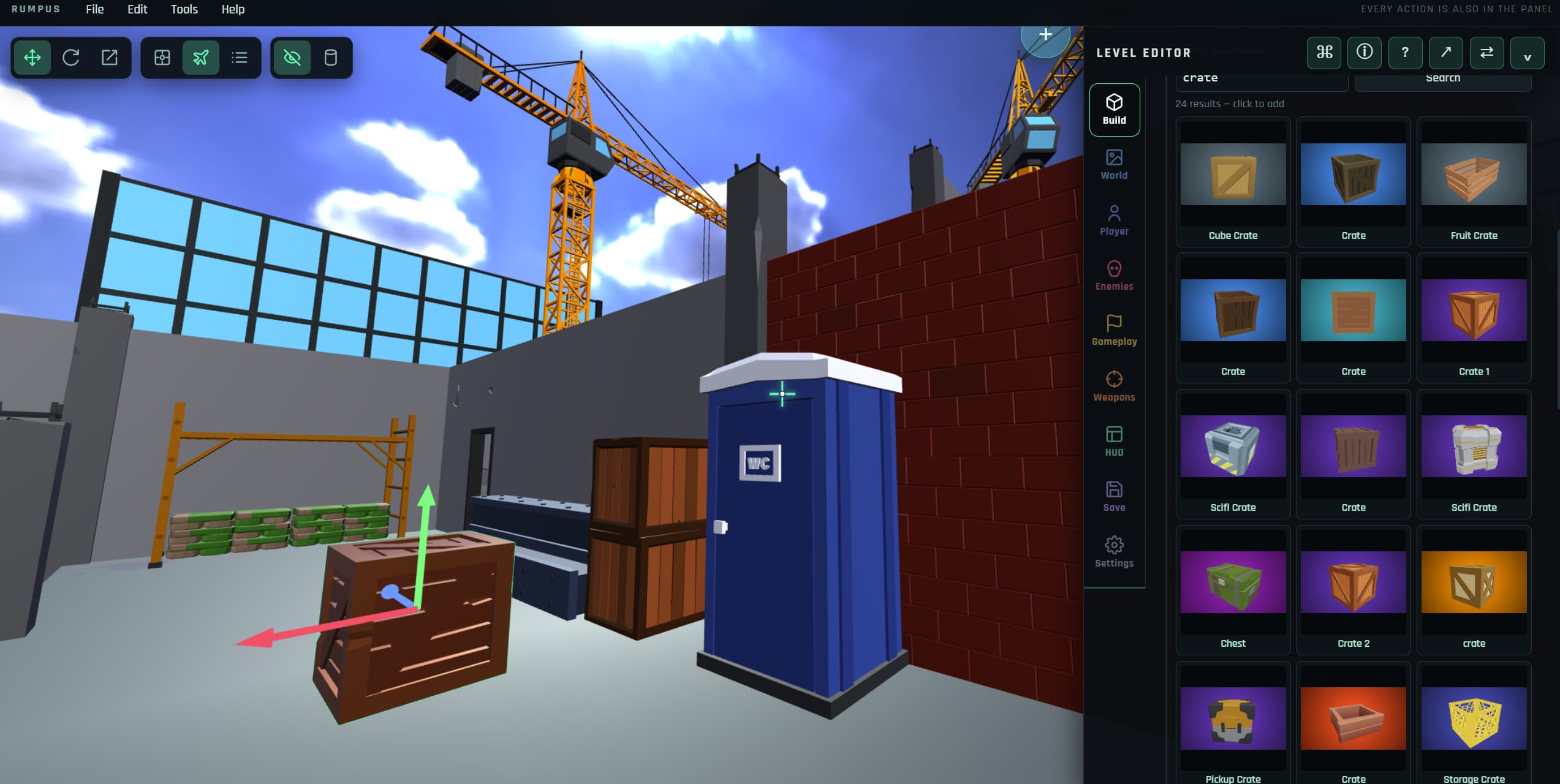
Pick by what stops you finishing. If installation and learning a language are the barrier, use a browser-based visual engine like Rumpus Engine (3D) or GDevelop (2D). If you want an engine you will never outgrow and don't mind writing code, use Godot. If you need native console and store export or a large asset ecosystem, use Unity or Unreal.
The best engine for a beginner is almost always the one with the shortest path to something playable, because finishing a small game teaches more than configuring a large engine.
Side by side
| Engine | Install | Coding | 3D | Multiplayer | Publishes to | Cost |
|---|---|---|---|---|---|---|
| Rumpus Engine | None — browser | None | Yes | Built in, P2P | A web link, community library | Free |
| Godot | Desktop | GDScript / C# | Yes | Networking API, you build it | Desktop, mobile, web, console via third parties | Free, open source (MIT) |
| Unity | Desktop | C# | Yes | Services and packages | Desktop, mobile, web, console | Free tier with conditions above a revenue threshold |
| Unreal Engine | Desktop, large | Blueprints or C++ | Yes, high end | Strong built-in | Desktop, mobile, console | Free, royalty above a revenue threshold |
| GDevelop | Browser or desktop | Event sheets | Mainly 2D | Limited | Web, desktop, mobile | Free, open source |
| Construct 3 | Browser | Event sheets | Mainly 2D | Add-ons | Web, desktop, mobile | Limited free tier, subscription |
| PlayCanvas | Browser | JavaScript | Yes | You build it | Web | Free tier (public projects), paid plans |
| Roblox Studio | Desktop | Lua | Yes | Built in | Roblox only | Free |
Licensing and pricing for commercial engines change — check current terms before committing to a project you intend to sell.
Where Rumpus Engine is the right choice
- You want to build in 3D without learning to code. Most no-code tools are 2D; most 3D engines expect a language.
- You can't or don't want to install software. A school or work machine, a Chromebook, a borrowed laptop.
- You want people to actually play it. Sharing is a link that opens into the game — no download, no store page, no install friction for your players.
- You want to iterate fast. No build step: P flips between editing and playing in the same session.
- You want multiplayer without running a server. Peer-to-peer co-op and PvP with a room code, included.


Where it is the wrong choice
Genuinely — if any of these describe your project, one of the engines above will serve you better.
- You need to ship on Steam, consoles or app stores. Rumpus publishes to the web. Use Unity, Unreal or Godot.
- You are building a huge open world. A browser tab has a memory budget and everything loads over the network. Browser engines suit tight, fast-loading games.
- You want to write custom systems. There is no scripting layer to extend. If you want to program your game, Godot or Unity will feel liberating rather than limiting.
- You are making a 2D platformer or puzzler. A dedicated 2D engine like GDevelop or Construct will be a better fit than a 3D engine with a side-scroll camera.
- You need a large asset store and plugin ecosystem. Unity's is unmatched for pre-built systems.
Questions people ask
Is Unity or Godot better for a beginner?
Godot is lighter, fully open source, installs in moments and attaches no conditions to your revenue. Unity has a bigger asset store, more tutorials and wider industry adoption. Both need a desktop install and code. If avoiding those two things is the point, start in the browser instead.
Can I sell a game made in a free engine?
Usually, but the terms differ and change. Godot is MIT-licensed with no revenue conditions. Unity and Unreal attach conditions above certain revenue thresholds. Rumpus Engine is free to use and publishes to the web rather than to native storefronts, so it suits sharing and portfolio work more than paid release.
Should I learn a "real" engine instead?
Eventually, if you want a career in games — but level design, pacing, encounter layout and game feel are the transferable skills, and you can learn all of them faster in a tool that lets you test an idea in minutes. Finishing three small games beats abandoning one large one.
What is Rumpus Engine built on?
three.js for rendering over WebGL, the Rapier physics engine compiled to WebAssembly, and PeerJS over WebRTC for peer-to-peer multiplayer. The whole engine ships as one HTML file.
Ten minutes will tell you more than this page
It's free and there is nothing to install. Open it, build something small, decide for yourself.
Open the editor